With up to 14% of American adults working from home, companies are revising their approach to productivity management. Techniques like keystroke tracking and screen time analysis are getting more common — but they can backfire, causing stress for employees and undermining trust in the company.
In this article, we’ll discuss how businesses are trying to monitor their remote workers and how they can do it better.
How companies monitor remote teams
Companies — about 80% of them — use monitoring systems to find out if remote employees are actually doing their work or just watching YouTube and hustling on the side.
Here are the most common forms of monitoring:
There’s plenty of monitoring software out there. Sneek automatically takes pictures from a webcam once a minute so that managers can see who’s at work. InterGuard tracks workers’ activity every five seconds, recording logins, keystrokes, applications launched, and other activity.
Wait, is this even legal?
From a legal standpoint, companies have the right to use such tools if they notify employees in advance.
Moreover, when used wisely, monitoring really helps: managers gain a better understanding of how working time and resources are spent, which tools could come in handy, and which tasks are causing difficulties. Monitoring also plays an important role in ensuring information security and compliance with industry regulations, especially in the financial sector and healthcare.
With that said, this kind of surveillance can certainly cause alarm, like something out of 1984. In the following sections, we’ll discuss risks and how to minimize them.
Downsides of monitoring
Arguable effectiveness. Studies provide mixed assessments of the effects of monitoring. Some show that it increases employee focus, persistence, and productivity, potentially due to the Hawthorne Effect, whereby employees work harder when they know they’re being watched.
There are two problems here. First, the Hawthorne Effect is considered ambiguous, as other factors may need to be in place for it to apply. Second, some studies have shown that monitoring has little effect on productivity — but it does reduce job satisfaction, raise stress levels, and increase the likelihood of counterproductive behavior.
{{_highlight-module-grey}}
Privacy concerns. A common complaint about monitoring is that it violates employees’ privacy, even if the employer isn’t breaking any laws. Plus, there’s always a risk that third parties might get access to employee data.
To maintain transparency, businesses need to clearly inform employees in advance what data is being collected and for what purpose. They also need to take cybersecurity extremely seriously to protect personal information.
Legal consequences. Different countries (and even individual U.S. states) have their own rules regarding the collection and processing of employee data. Failure to comply can result in fines and lawsuits. For example, Amazon was fined $35 million for using an “excessively intrusive” system to monitor employee productivity and activity. Apple was accused of secretly monitoring employees through their work iPhones.
Companies can avoid these problems by consulting with lawyers and creating clear policies for collecting, storing, and using information.
Getting monitoring right: Trust and support instead of total control
The human touch seems to be key to effective monitoring. According to an HBR study, monitoring based on live interaction (regular calls, discussions of goals, and feedback) strengthens trust within a team and stimulates innovation. Conversely, more automated forms of monitoring (tracking time, activity, or keystrokes) can stifle communication and reduce engagement, especially for those in “complex roles,” such as developers, product managers, and strategic consultants.
Many leaders and managers have acknowledged that excessive control is demotivating, while trust, transparency, and autonomy are the foundation of productivity.
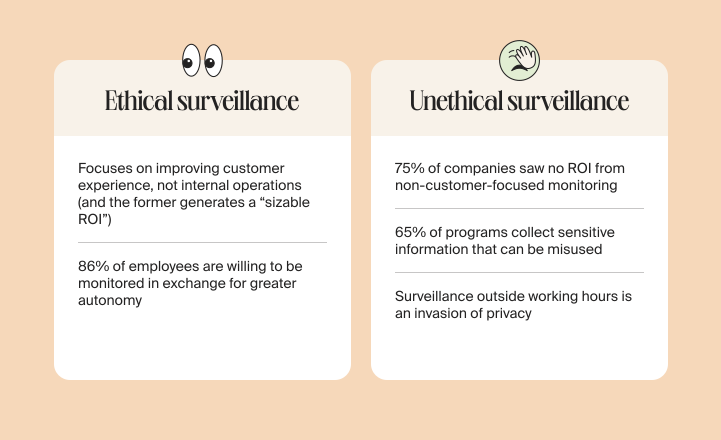
An article in the MIT Sloan Management Review proposes that we think in terms of ethical vs. unethical (or overly strict) surveillance:
In designing monitoring policies to be ethical, companies would do well to adhere to these principles:
Have open discussions. Answer employees’ questions about monitoring methods. They should understand why monitoring is being carried out, how it works, and why particular methods were chosen. Remember that monitoring is most beneficial when it’s aimed at improving the customer experience, rather than spying on workers.
Describe the benefits. Make clear that employees will gain greater autonomy in exchange for monitoring: 86% of employees polled said they were open to that trade-off.
Set clear boundaries to protect workers. Monitoring outside working hours is unacceptable. Companies should inform employees how and where their data is stored and who has access to it.
Connect HR tools. Monitoring will not increase efficiency without effective HR processes in place. Before resorting to monitoring, companies should review their approach to hiring and set clear expectations for all employees — this reduces the need for control.
One HR technique that can reduce the need for monitoring is outcome-based management. In this approach, the focus is on employee achievements, not the minutiae of how they spend their days.
According to Microsoft, this is a characteristic of Frontier Firms — companies that will remain effective in the age of AI by quickly adapting to new technology and new cultural demands.