on emerging workplace trends
leverage Mellow for growth
Hiring Independent Contractors in Albania: Essential Tips
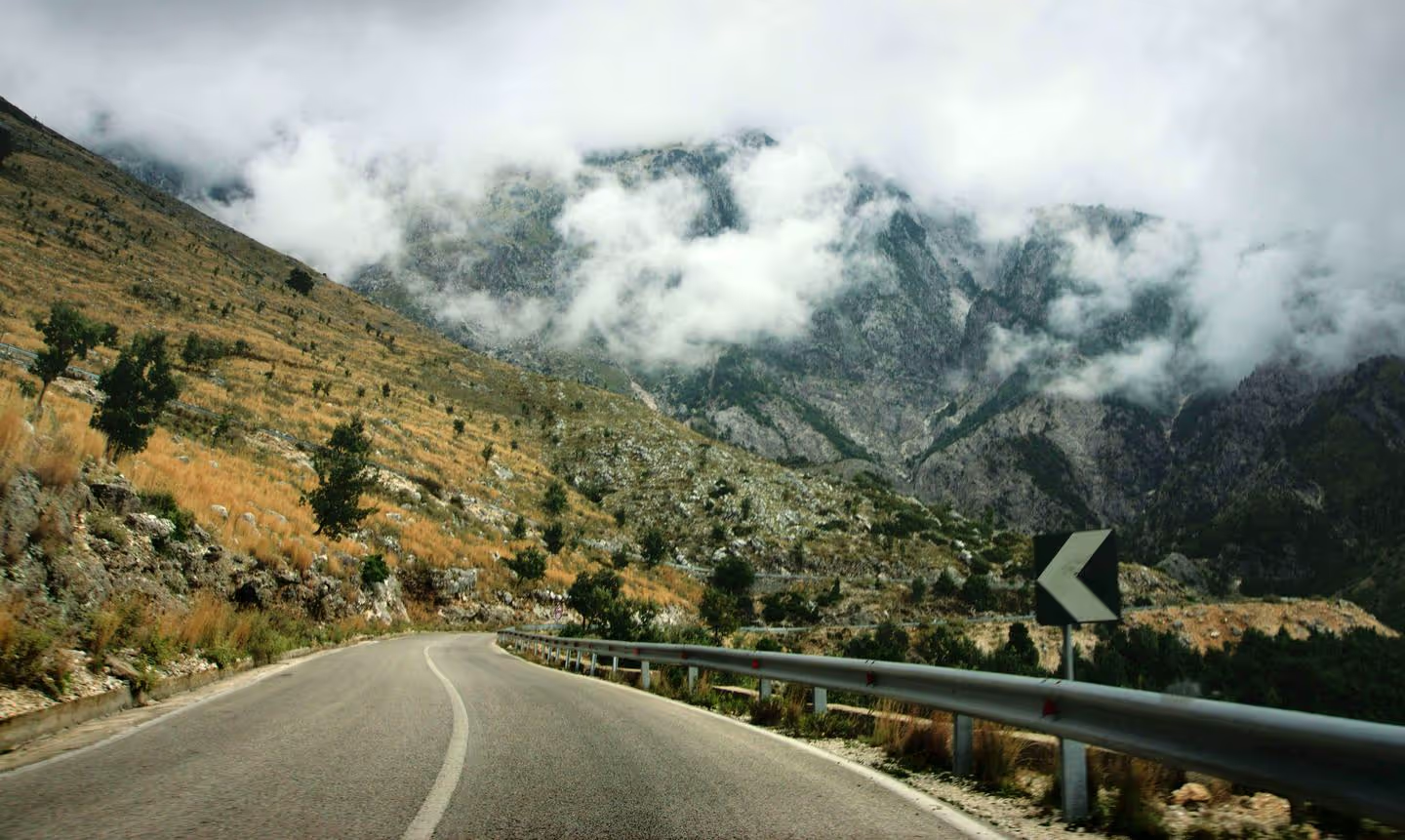
Albania has quickly become a competitive place to find an extremely skilled, multi-lingual and affordable labor force in the Balkans. Having a convenient location close to the European Union and a workforce that is usually fluent in English, Italian and German, the "Land of the Eagles" is an attractive offer to remote-first organizations. Nevertheless, the way to the successful hiring of independent contractors in Albania is covered with certain regulatory issues, tax peculiarities, and cultural anticipation that are far below the Western European or North American expectation.
This guide is a detailed roadmap on the way to go in the Albanian environment in 2026 when you are a business leader and HR professional and it is crucial to make the interaction with local talent not only legal but effective.
Understanding Independent Contractors in Albania
Definition and Overview
In Albania, a separate contractor will be legally a "Person Fizik" (Natural Person/Sole Proprietorship). These people are enlisted in the National Business Center (QKB) as independent economic actors. In contrast to an employee who serves as part of the internal structure of the company, a contractor in Albania is an independent business organization, which offers services in accordance with charge.
The relationship is fundamentally commercial, governed by the Albanian Civil Code, specifically the provisions regarding "Contracts for Work" or "Service Agreements" (Kontrata e Shërbimit).
Differences Between Independent Contractors and Employees
Separating an employee and a contractor is a subject of great attention of the Albanian Labor Inspectorate. The main distinguishing factor is that of subordination.
- Subordination: An employee is subordinated to a direct authority and supervision by the employer. On the other hand, the contractor retains independence in doing the work.
- Tools and Equipment: The employees usually utilize the resources provided by the company. The contractors are supposed to bring their own laptops, software and workspace.
- Exclusivity: Although employees are typically not permitted to take up secondary employment, in Albania, contractors are at liberty to work with more than one client unless a non-compete is stated specifically and reasonably.
- Payment Structure: Employees are given monthly income and tax is deduced. Contractors charge services they render usually on the milestones or agreed deliverables.
Legal Relationship and Rights
Contractors do not fall under the Albanian Labor Code. This means they are not entitled to statutory benefits such as:
- Paid annual leave (minimum 20 working days for employees).
- Sick pay or maternity/pension benefits from the employer.
- Severance pay or strict notice periods (unless specified in the civil contract).
- Protection against unfair dismissal under labor law.
Rather, they are allowed to be served only in accordance with the service agreement. In case of a dispute, it does not go to labor court, rather it goes to civil court.
Benefits of Hiring Independent Contractors in Albania
Cost Savings
One of the most immediate benefits of hiring independent contractors in Albania is the reduction in employer-side costs. In the case of a standard worker, the employer has to provide about 16.7 percent of the gross salary in terms of the social and health insurance contributions. In the case of a contractor, these expenses are done away with, since the contractor will have to do his/her insurance and tax returns.
Access to Skilled Labor
There has been an impressive change in the education system towards STEM and foreign languages in Albania. There is a high density of developers, graphic designers, and digital marketing specialists who are used to international working standards in the country. A significant number of Albanian specialists prefer to work under the contractor model (Person Fizik) and ensure greater net income at the same time offering their services to the world's technological centers.
Cultural Knowledge and Market Practices
In case your company intends to expand into the Balkan region, the local contractors can offer invaluable information on the market forces and the local consumer patterns. The Albanian work culture is defined by a traditional code of honor called as "Besa" that is based on the importance of keeping his word that can also be translated into high reliability and loyalty within the workplace.
Flexibility and Scalability
Contractors enable firms to increase or decrease the size of teams without the legal challenges of mass layoffs or the overhead burden of recruiting full-time employees into a local compensation structure.
Legal Framework for Independent Contractors in Albania
Labor Laws and Regulations
Although not applicable to the Labor Code, service contracts have the legal basis established by the Civil Code of the Republic of Albania (Articles 850 876). A significant aspect in 2026 is the Fiscalization Law that obliges all business entities (including the contractors) to make the electronic invoices that are reported to the tax authority in real-time.
Contract Structures and Rights
When you hire independent contractors in Albania, the contract must be robust. It should include:
- Scope of Work: Specific deliverables to prove the lack of an employment relationship.
- Payment Terms: Fees per milestone or project.
- Intellectual Property: An explicit clause stating that all IP created belongs to the client.
- Data Protection: Clauses aligning with Albania’s Law on Protection of Personal Data (which mirrors GDPR).
- Termination: Notice periods agreed upon by both parties.
Working Hours and Wages
Contractors are not bound with the working time, unlike employees who are limited to doing 40 hours a week. But to prevent this miscarriage of justice, it is cultural not to stipulate certain office hours but specify certain delivery deadlines. Contractors do not have any established minimum wage but they are required to charge at market rates or risk tax evasion.
Tax and Compliance for Contractors in Albania
Navigating Albanian taxes is often where international employers feel the most "pain." In 2026, Albania maintains a progressive and sector-specific tax regime.
Income Tax Obligations
Historically, Albania offered a 0% tax for small businesses. However, as of January 2024 (and continuing into 2026), professional services (including IT, consulting, engineering, and accounting) are taxed at:
- 15% for net taxable income up to 14,000,000 ALL (approx. €140,000) per year.
- 23% for any income exceeding that threshold.
Note: Smaller non-professional enterprises with less than 14 million of turnover can be subjected to a zero rate up to 2029, although the majority of remote workers employed by tech companies will be subject to 15%.
Value Added Tax (VAT)
The VAT registration threshold is 10,000,000 ALL in annual turnover.
- If the contractor earns less than this, they are "VAT exempt" and do not charge VAT.
- If they exceed it, they must register and charge 20% VAT.
- Important: For services exported to a foreign company (B2B), the 0% VAT rate usually applies under the export-of-services rule, meaning you, the employer, likely won't pay Albanian VAT.
Social Security Contributions
Contractors in Albania must pay their own social and health insurance. As of 2026, the minimum monthly base for contributions is 50,000 ALL.
The formula for mandatory monthly contributions is:
Social Insurance = 50,000 x 23% = 11,500 ALL
Health Insurance = 100,000 (double the minimum salary) x 3.4% = 3,400 ALL
Total Fixed Monthly Contribution = 14,900 ALL
How to Pay Independent Contractors in Albania
Paying talent in Albania requires a balance between speed and compliance.
- SWIFT/International Wire Transfer: Banking Albanian institutions such as BKT, Raiffeisen, and Credins are efficient when it comes to international transfers but the contractor may have to pay high fees.
- Global Payroll Platforms: Platforms like Mellow are highly recommended. They handle the contract localization, collect the necessary tax IDs, and allow you to pay in USD or EUR while the contractor receives the funds in their preferred currency.
- Fiscalization Compliance: You are to make sure that the contractor gives you an Invoice issued fiscalized, no matter what payment method is taken. It is a PDF file whose QR code is created by the Albanian Tax Directorate. Otherwise, the payment in some jurisdictions will not be a valid business expense.
Finding the Right Independent Contractors in Albania
Defining Your Requirements
You must first decide whether you require a Person Fizik (established freelancer), or a Natural Person. It is much safer to hire a contractor that is already registered, as far as compliance is concerned.
Utilizing Local Job Platforms
- DuaPune.com: The largest and most reputable job portal in Albania. It is the first stop for almost every professional in Tirana and Durrës.
- LinkedIn: Widely used by the tech and creative community.
- Portalipune.al: Another effective local alternative.
Engaging Recruitment Agencies
For niche roles, local agencies like The Headhunter or Randstad (Albania branches) can help filter candidates who have experience working with international remote teams.
Evaluating Contractor Profiles
Identify those who have experience in European-based or US companies. Such professionals will be conversant with Agile practices, Slack/Jira communication and the need to deliver deadlines in a remote setup.
Challenges of Hiring Contractors in Albania
Complicated Labor Laws
Although it appears easier to simply hire a contractor, the possibility of being misclassified is a fact. Assuming that your so-called contractor is, in fact, an employee, on top of the fines (usually between 50,000 and 200,000 ALL per offense) you may be ordered to make back-payment of social security and income taxes over the entire life of the contract
Payroll Challenges
Albania is still not a member of SEPA (Single Euro Payments Area) although it is currently being requested to join. This implies that EU transfers might take between 2-5 days and have to pay intermediary banks.
High Youth Unemployment Rate
As there is much talent, there is also a high unemployment rate of young people in non-technical jobs. This will result in an influx of unqualified generalist candidates. Rigorous testing and portfolio reviews are essential when you hire an independent contractor in Albania.
Converting Contractors to Employees in Albania
Should a contractor develop to be an important aspect of your core team, then you might consider making him an employee so that he or she will enjoy greater security and that you protect your IP more comprehensively.
To convert a contractor, you have three paths:
- Direct Entity: Open an Albanian Sh.p.k. (Limited Liability Company). This is only worth it if you plan to hire 5+ people.
- Employer of Record (EOR): Use a third party to hire the individual on their Albanian payroll. You remain the functional manager, but the EOR handles taxes and benefits.
- Full-Time Remote (Non-Resident): There are companies that attempt to employ them as distant workers and who lack a local company, but it is legally tricky and tends to leave the employee without a local health care or pension plan.
Conclusion
The employment of Albania in 2026 provides agile firms with an opportunity for the world. With a set of known Person Fizik contractors, the use of fiscalized invoices and the strict division of the delivery of the service and employment, you can have a high-performing Balkan team with a minimum of risk.