Rethinking Talent: How Skills-Based Marketplaces Are Changing the Way Companies Scale

Talk about a double whammy: automation and AI mean that the skillsets for millions of jobs will be transformed over the next few years. At the same time, experts are predicting serious labor shortages in economies around the world.
To prepare for these massive changes, some companies are shifting their approach to management to models based on skills, not positions, and often by using internal talent marketplaces (ITM).
Management through skills
In the skills-based model, the focus is less on staff structure than on which tasks are on the company’s plate and which employees can handle them. Managers can make faster decisions, and employees (including freelancers and contractors) get more opportunities for growth.
According to Deloitte, 84% of employees consider skills more important than positions, 71% already perform tasks outside their job description, and only 24% do the same things as others with the same job title.
.svg)
Employers see things similarly. Sixty-one percent of executives believe that automation and AI are accelerating the shift to managing through skills, and 77% of HR and senior managers believe “flexibly moving skills to work is critical to navigating future disruptions.”
Advantages of a skills-based model
Aside from flexibility, companies that have adopted this approach are 63% more likely to succeed than those who stick to the position-based model.
And yet, only 20% of HR leaders have implemented the skills-based model — though 89% say doing so is important or critical.
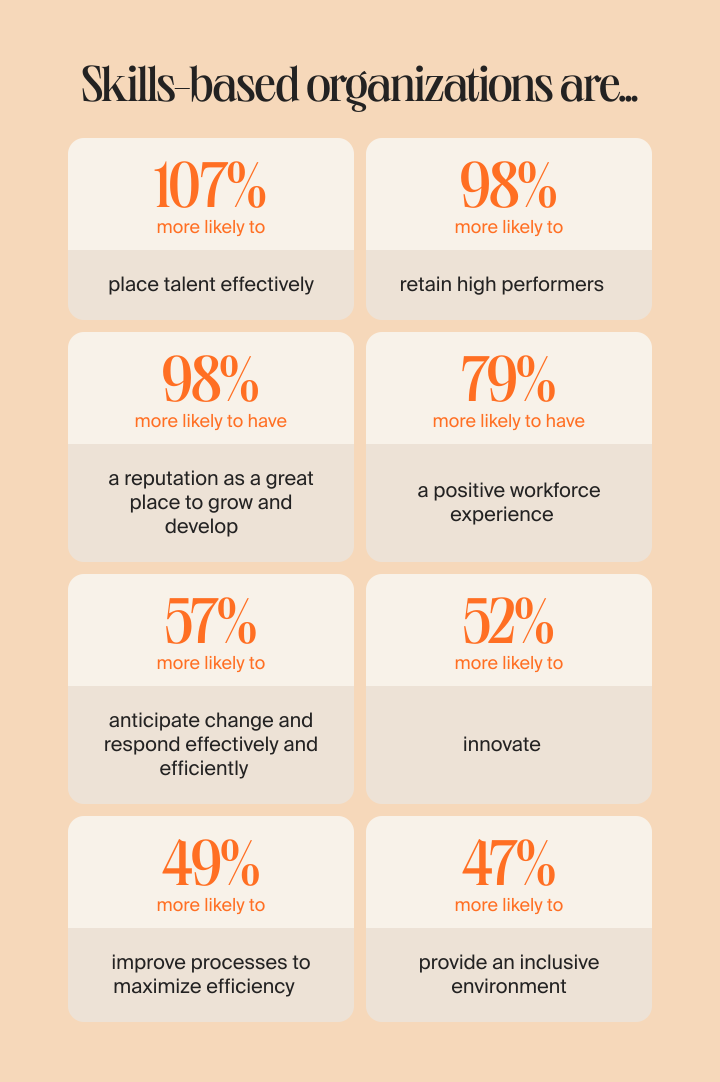
Pillars of the skills-based model
To successfully allocate tasks by skills rather than positions, companies need competency data and the tools to handle it. Key elements here include:
- Skills taxonomy — A skills map showing what employees are good at, which competencies the business needs, and where the gaps are.
- Skills intelligence — AI-based skill matching technology that updates profiles, matches skills to tasks, and suggests areas for development.
- People analytics — Which competencies are obsolete, where deficits are, and where there’s potential for growth.
- And finally, an internal talent marketplace — An interface that embodies this approach as a functioning tool.
What an ITM is and how it works
An internal talent marketplace (ITM) is a digital platform that connects employees with opportunities within a company. These might be job openings, temporary projects (internal gigs), training, mentoring, or new career tracks.
Unlike external platforms (freelance services, job boards), ITMs focus on unlocking the potential of existing employees. It extends the classic model of internal mobility — but bases it on skills and interests, not predetermined job ladders.

Talent marketplace software can be used as a separate platform or integrated into the company’s existing HR system and training systems (LMS or external courses). It can also support career pathing (automatic creation of growth trajectories) and communication with internal communities (ERG) to keep the company’s development centralized and cohesive.
How ITMs work in practice
ITMs are designed to handle three basic scenarios:
- An employee looking for growth
- A company looking for workers with certain skills
- A company trying to manage its development in real time

Here’s how it works:
- Employees fill out profiles, listing their skills, experience, interests, and goals. The system can add some data automatically based on each person’s participation in projects, courses, etc.
- The platform suggests suitable tasks, positions, and training programs.
- Managers can see which employees are available, who can move, and where additional resources are needed.
- The system records changes: who’s moved where, who’s learned which skills, how employees are developing. This helps the company manage people based on data rather than subjective assessments.
This forms an internal talent network — a companywide platform with a complete overview of people, skills, and workloads. Some companies extend the ITM to freelancers and contractors if they work with them regularly.
{{_b2b-case}}
Two types of ITM
Internal marketplaces can be built in different ways depending on the size of the company, the maturity of its HR processes, and its technical infrastructure. Today, there are two main models.
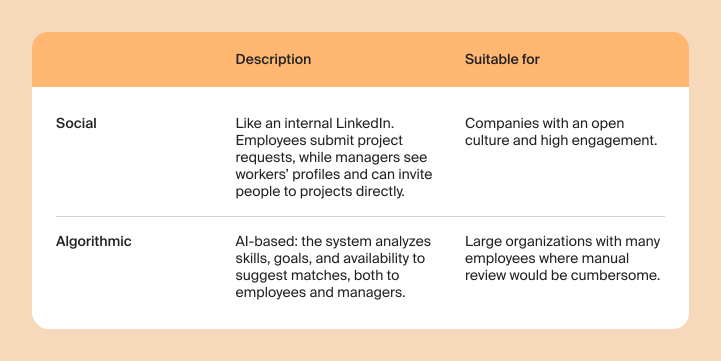
Often, a hybrid format with elements from both models is used. Employees receive recommendations but can also apply to projects on their own.
In mature organizations, ITMs can be embedded into the overarching system of workforce planning and performance/capacity management.
When and why to launch an ITM
Below are five situations where an ITM can help a business act faster, more effectively, and at a lower cost.
1. High external recruitment costs
New hires’ salaries can be 18% more expensive than those of internal promotions — and finding them takes time. An ITM allows you to get tasks done with existing employees.
Case study: Schneider Electric launched an ITM for its 135,000 employees. Sixty percent of them started using the system within two months, saving $15 million and generating +550,000 hours of engagement.
2. Low visibility of internal resources
In large or distributed companies, it can be hard to know who has what skills. ITMs fix that problem.
Case studies: Unilever implemented its FLEX platform for 60,000 employees in 100 countries, filled many vacancies internally, and reduced its hiring rate by 75%.
SAP has an Opportunity Marketplace that lets employees receive personalized guidance (training, temporary roles, or mentoring) no matter what their department or location.
3. Limited internal mobility
Employees — whether generalists or specialists — can get stuck in one role, even if they have the potential to contribute elsewhere. An ITM helps surface their skills and match them with relevant opportunities.
Case study: When Google merged a generalist division with a specialist one, it expanded its ITM to include the latter. A year later, in an internal survey, 80% of employees and managers said they were happy with the platform, and internal mobility had increased markedly.
4. Problems with retention
According to Gallup, 48% of employees in the U.S. would leave their current job if offered a better opportunity. This was an issue at Schneider Electric before it implemented its ITM: almost half of employees who left cited a lack of growth opportunities.
Companies with high employee engagement reduce staff turnover by 21–51%. Engagement comes from a number of factors, including opportunities to develop within the company.
5. Periods of change
When change occurs, it’s important to reallocate resources quickly, and ITMs are perfect for this.
Case study: Seagate launched its internal marketplace Career Discovery during the pandemic. Over four months, it reported $1.4M and +35,000 hours in savings. The ITM allowed the company to form teams without location or language restrictions, accelerating adaptation and strengthening its culture of “talent without borders”.
How to implement an ITM
It’s not as simple as just installing talent marketplace software. Using an ITM effectively requires systematic preparation.
.svg)
You’ll need, at a minimum, these four things:
- A platform. Own or off-the-shelf — the key thing is that it should integrate with the current HR environment.
- A skills taxonomy including profiles, matrices, and frameworks. It can be adapted from an off-the-shelf model or built from scratch to meet your company's needs.
- Training. Employees need to understand how the ITM works, and managers need to know how to use it in the interests of the business.
- Internal positioning. ITMs aren’t about “taking people away from my team!”, but about growth, development, and flexibility.
Common problems
Even with a well-prepared launch, difficulties can arise. Here are five frequent problems and how to deal with them.
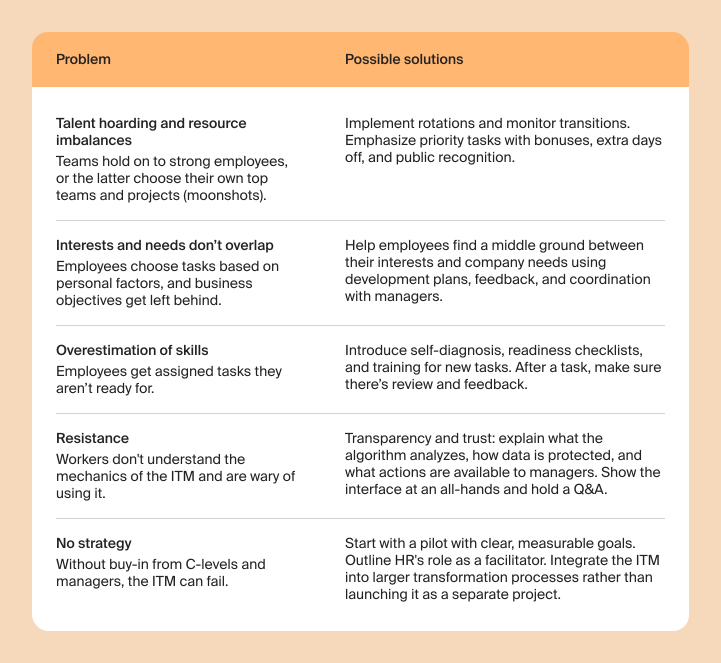
An internal talent marketplace isn’t a replacement for HR — it’s a tool for creating a culture of growth. It helps you make internal opportunities visible and career tracks accessible.
To make it work, you need to prepare well, balance the interests of various stakeholders, and outline a clear strategy. Build out systematically: start with a pilot program in a key division, create a skills map, train managers, and gradually scale up your ITM.
Recommended






“Mellow's most significant advantages are fast onboarding, quality support at all stages, and a user-friendly interface. Cryptocurrency is set to continue rising in popularity as a preferred payment method, and here are five reasons why”.
Join our Telegram channel
join us for expert insights.