Five Key Legal and Operational Risks When a Game Studio Does Cross-Border Hiring

Game development has always been constrained by two things: time and talent. Today, one of those constraints is disappearing.
Studios are no longer limited to hiring within commuting distance of an office or even within a single country. The global talent market is fully accessible — whether you need a Unity developer in Poland, a concept artist in Brazil, or a backend engineer in Southeast Asia.
But while access to talent has become global, regulation has not.
Every country brings its own rules around employment classification, taxation, intellectual property, and data protection. And unlike production workflows, these rules do not seamlessly integrate. They overlap, conflict, and, in many cases, create hidden risks that only become visible when something goes wrong.
If you’re working through Mellow:
- You’re completely covered when using Contractor of Record (CoR) because your company signs a single contract with Mellow, and we, as the provider, make contracts with all of your remote professionals on your behalf.
- Or you can still hire workers directly using the Contractor Management platform. However, since payments are still processed through Mellow, this also makes you completely safe regarding the majority of issues discussed in this material.
But what if you want to hire someone directly, without using Mellow?
In this article, we’ll break down five key risks that game studios encounter when working with freelancers across borders — and what to pay attention to before these risks turn into real problems.
But keep in mind that legislative requirements may vary across jurisdictions; to clarify the applicable regulatory details, always check with a doctor — that is, a lawyer.
1. Work with a freelancer resembles employment? You may encounter fines and penalties
The first and most common problem when working with a freelancer from another country is that if your work resembles permanent employment, you risk encountering legal difficulties.
Regulators in most jurisdictions assess the substance of the relationship, and not how you position or name it.
And the fact that your work is based on a “contractor agreement” does not mean that it will be classified as such by regulators.
If a freelancer works fixed hours, is integrated into internal workflows, uses company tools and email, reports to managers like an employee, then the legal classification may shift, regardless of what the contract says.
In legal terms, this is called misclassification: the claim that a de facto full-time employee is a freelancer. If local regulators conclude that you are only labeling your freelancer as such, then you may have to deal with retroactive tax payments, social contribution liabilities, fines and penalties, and a reclassification as employment.
To sum up, we can say that for regulators the actual structure/substance of the relationship matters more than its name.
2. Hire a freelancer? Their country can set the rules
When you are working with a freelancer from another country, your relationship and interactions are regulated by the local laws of the place where they live, not your home jurisdiction.
The key thing here is where the actual work is physically performed, in which country's territory, and it doesn’t matter what governing laws your contract states. That’s why working with any freelancer from afar should begin with studying their country of residence's labor laws.
Be sure to look into:

In many jurisdictions, copyright does not transfer automatically without a precise written assignment. In other countries, withholding tax applies even when paying independent contractors.
To sum up, every country operates under its own regulatory regime. Address it before the first invoice goes out.
3. A generic NDA template — is it enough? Not always
Sending a standard NDA to a freelancer in another country does not automatically protect sensitive information of your game development company.
In reality, courts look at substance: what has actually been done to protect it? They ask: Did the company take real, reasonable measures to protect confidential information?
Your agreement must clearly define what is protected:
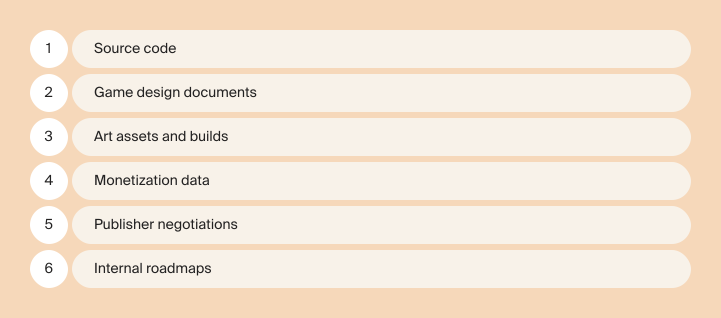
And if it is full of general wording like “all business information”, it will greatly weaken its enforceability.
Confidentiality is also operational. If a freelancer has full repository access without limitation, stores builds on personal devices, keeps credentials after termination, then your trade secret protection weakens — even with a signed NDA.
Another important aspect is that your NDA with every particular freelancer needs to be designed to have the legal power for cross-border enforceability. A governing law clause in your contract does not guarantee that a foreign court will enforce penalties or damages.
In conclusion, it should be noted that an NDA is evidence of intent. Security, access control, and documentation are evidence of protection, which can later help with enforceability.
4. In gamedev, IP is the asset — protect it
In game development, IP is the core asset. Yet many studios rely on generic contractor templates that:
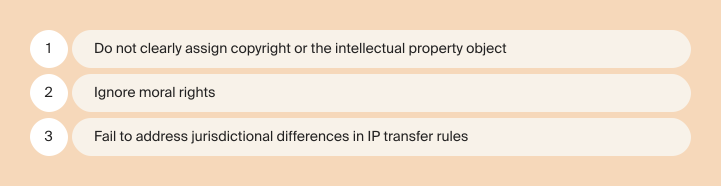
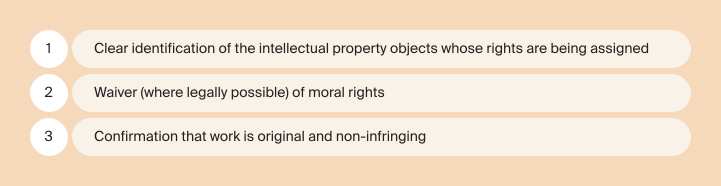
In some countries, copyright does not automatically transfer to the client unless explicitly assigned in writing. In others, moral rights cannot be waived entirely.
{{_highlight-module-grey}}
Every freelance agreement should include:
In today's world, digital nomads are constantly moving between different countries. And sometimes it can cause a problem. For example, if a freelancer changes residence and works more than 183 days in a new country, tax residency may shift, which, in turn, can change tax burden and add additional tax administration for the company.
Sometimes, even one day is enough. For example, if you’re visiting the Netherlands, where tax residency is determined by facts and circumstances. Meaning, you can become a tax resident on your first day if you establish social and economic ties there.
A change in jurisdiction like that can affect:
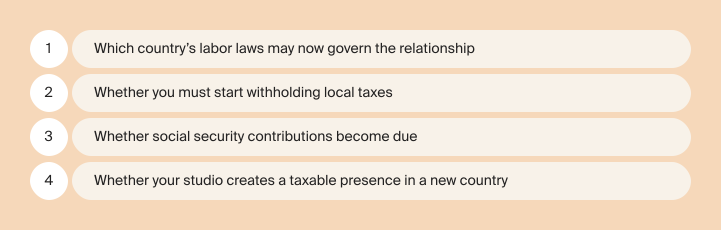
A freelancer’s relocation alone may trigger new registration, reporting, or payment requirements for your company. If several contractors move across borders during the year, the risk compounds. You may end up exposed in multiple jurisdictions at once — often without realizing it.
At that point, compliance stops being a one-time setup and becomes an ongoing monitoring task. Without clear internal processes — tracking residency, time spent in each country, and contractual updates — the situation quickly grows beyond ad-hoc management.
Global hiring works, but mobility requires structure.
Global talent won’t wait — build the studio that can keep up
Cross-border work thrives with a good infrastructure and strategic approach.
Whether you build it internally or rely on a partner, the goal is the same: reduce uncertainty, standardize processes, and ensure that every new hire does not introduce a new layer of risk.
Because global hiring is not just about accessing talent — it’s about being able to work with that talent repeatedly, predictably, and at scale.
But not everyone wants to navigate the intricacies of cross-border operations and hire a team of lawyers to manage the process, instead of focusing on building games.
If your game studio wants to expand quickly into new regions and delegate the majority of administrative and legal complexities to a partner who will handle them, then the Contractor of Record option is right for you.
If, on the other hand, it’s important for you to have direct contracts with remote professionals, you can use the payment infrastructure and many other features of the Contractor Management platform while establishing a legal relationship between you and each contractor.
Recommended






“Mellow's most significant advantages are fast onboarding, quality support at all stages, and a user-friendly interface. Cryptocurrency is set to continue rising in popularity as a preferred payment method, and here are five reasons why”.
Join our Telegram channel
join us for expert insights.